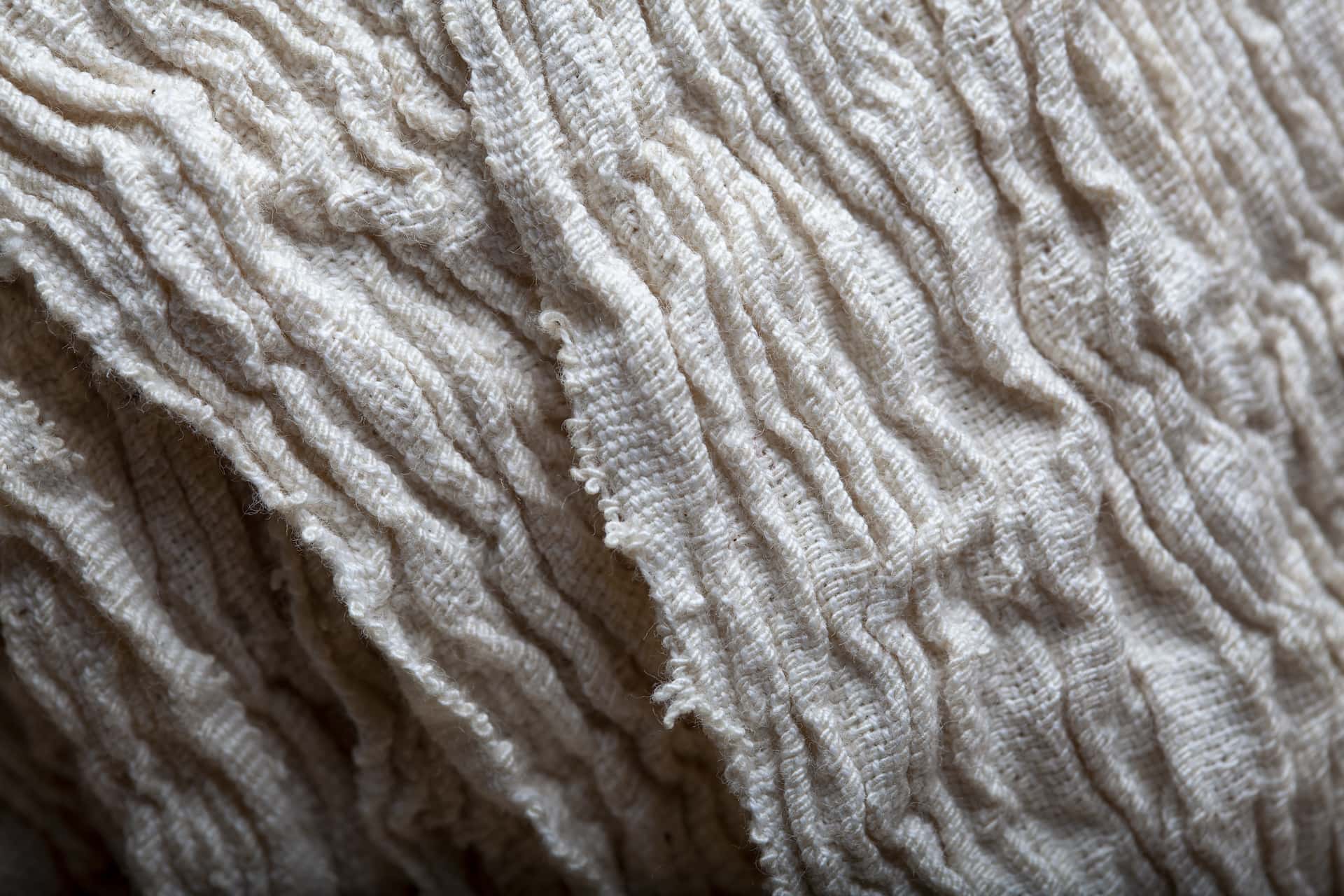
BÜRÜMCÜK (CREPE)
In the travel books of İbn-i Batuda and Evliya Çelebi, it is mentioned that bürümcük was woven from Anatolia’s high-quality cloths and for the palace due to its superior properties. In the Narh Book of 1640, bürümcük was recorded with places such as “Sade, Çubuklu, Siyah Çubuklu, Alaca, Arnavut Boyalı, Serfice, Mardin, and Alaşehir”. With the encouragement of General Kazım Dirik, who served as the governor of İzmir between 1926-1935, aprons made from it were used in all schools within the borders of Buldan. This practice, which opened a large market area for Anatolian weaving, continued until 1950. Although regions such as Denizli-Buldan, İzmir-Ödemiş-Birgi, Karabük, Antalya, Bilecik, Manisa-Alaşehir, Muğla, İstanbul, and Mardin stand out, bürümcük is one of the most widely woven weaves in the whole country. Today, it is still woven in many places.
Natural white cotton, silk, linen, and rarely wool were used as materials. Bürümcük is woven in plain weave technique with normal twisted warp and multi twisted weft. After the weaving is completed, it is washed with hot soapy water and it gains the characteristic wrinkling feature and the width becomes narrower. Because of this feature, bürümcük fabrics are used especially for underwear production. They have no patterns. In some examples, it is observed that both warp and weft are woven using multi-twisted thread.
Bürümcük is one of our national woven fabrics in which exclusive and specific techniques are used and it varies with different materials used. There are many types of bürümcük such as Şile Cloth, Buldan Cloth / Twisted Cloth. Although it is named differently according to the place it is woven, the weaving technique is similar or the same. It was used in the production of shirts, pants/shalwars, undershirts, garment linings, quilt linings, and underwear.